



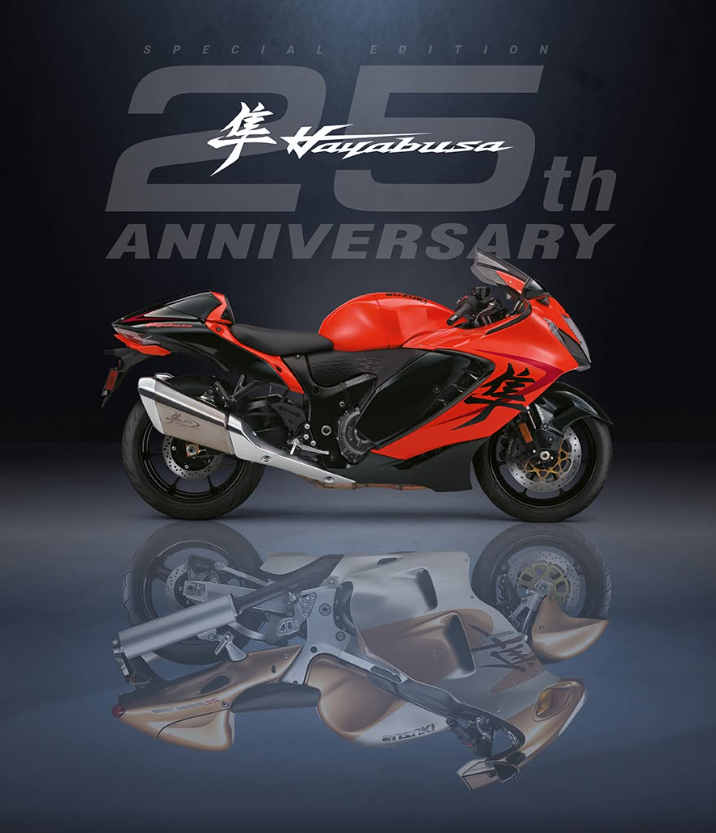

25 Years of Speed: The Legendary Suzuki Hayabusa Journey in India (2001–2026)
Few machines command as much awe, respect, and pure obsession on Indian roads as the Suzuki Hayabusa. Named after the Japanese Peregrine Falcon—a bird capable of diving at speeds over 300 km/h—the Hayabusa did exactly that to the motorcycling world. From its explosive introduction in India in the early 2000s to its high-tech avatar in 2026, the “Busa” has evolved from a raw speed monster into the ultimate sophisticated hyper-tourer.
Here is the complete story of the Suzuki Hayabusa’s historic run, its unparalleled craze in India, and how it stands today.
The Early Craze (2001): Cult Status & Pop Culture
Though launched globally in 1999, the Hayabusa truly began making waves in India around 2001 as private imports began trickling in. At a time when Indian roads were dominated by modest 100cc to 150cc commuter bikes, the sighting of a Hayabusa was nothing short of a UFO event.
The madness peaked universally in 2004 when the Bollywood blockbuster Dhoom hit the silver screen. The silver-and-black Hayabusa ridden by the antagonist became an overnight cultural phenomenon in India. It single-handedly defined the term “Superbike” for an entire generation of Indians. Even non-riders who didn’t know anything about displacements knew one word: Hayabusa.
The Evolution: Generation by Generation
Suzuki has meticulously refined the Hayabusa over nearly three decades. Rather than completely rebuilding the bike, they perfected an aerodynamic silhouette that is instantly recognizable anywhere on Earth.
Generation 1 (2001 – 2007): The Unrestricted Monster
- The Engine: 1,299cc liquid-cooled inline-four.
- Power Output: 175 PS.
- The Story: The early Gen-1 models were famous for breaching the 300 km/h barrier out of the box. This sheer ferocity resulted in the famous “Gentleman’s Agreement” of 2001, where global manufacturers agreed to electronically limit all future production bikes to 299 km/h. This generation was purely analog—no traction control, no ABS, just raw mechanical muscle.
Generation 2 (2008 – 2020): Muscle Meets Modernization
- The Engine: Increased to 1,340cc.
- Power Output: Bumped up to a massive 197 PS.
- The Story: Suzuki gave the bodywork sharper lines while retaining its aerodynamic prowess. More importantly, they introduced the Suzuki Drive Mode Selector (S-DMS), allowing riders to choose between three different power delivery maps. In 2013, Suzuki added standard ABS and Brembo front brake calipers.
- The Indian Milestone: In 2016, Suzuki Motorcycle India made a historic move by commencing local assembly (CKD) of the Hayabusa in Gurgaon. This slashed prices drastically by over ₹2.5 Lakh, fueling a massive sales surge across the country.
Generation 3 (2021 – 2026): The Refined Beast
- The Engine: Heavily revised 1,340cc engine (Euro 5 / BS6 compliant).
- Power Output: 190 PS and 150 Nm of torque.
- The Story: Unveiled globally in 2021 and continuing its dominance into 2026, the Gen 3 moved from pure horsepower wars to controllability and sophisticated electronics. While peak power dropped slightly to clear stringent emissions, the low-and-mid-range torque was significantly strengthened, making it faster in real-world acceleration.
- The 2026 Updates: For the latest 2026 lineup, Suzuki introduced a much lighter Lithium-Ion battery for improved voltage stability, an updated smart cruise control system that works through clutchless gear shifts, and a premium Special Edition variant finished in stunning Pearl Vigor Blue.
2026 Suzuki Hayabusa: Current Specifications
The current generation model is a masterclass in blending hyperbike speed with long-distance sport touring comfort.
| Feature / Component | Technical Specifications |
| Engine Type | 1,340cc, 4-stroke, liquid-cooled, DOHC, Inline-Four |
| Maximum Power | 190 PS @ 9,700 rpm |
| Maximum Torque | 150 Nm @ 7,000 rpm |
| Transmission | 6-speed with Bi-directional Quick Shifter |
| Top Speed | 299 km/h (Electronically Limited) |
| Electronics (S.I.R.S.) | 6-axis IMU, 10-level Traction Control, Cornering ABS, Launch Control (3 modes), Engine Brake Control, Cruise Control, Active Speed Limiter |
| Brakes | Front: Dual 320mm discs with Brembo Stylema calipers; Rear: Nissin caliper |
| Suspension | Fully adjustable KYB inverted front forks & rear monoshock |
| Kerb Weight & Tank | 266 kg with a 20-litre fuel tank capacity |
2026 Prices in India (Ex-Showroom)
Despite its legendary status and premium performance, local assembly helps the Hayabusa remain one of the most value-for-money superbikes in India. The ex-showroom prices for the 2026 models are:
- Standard Variant: ₹18,99,000 (Available in Candy Daring Red/Glass Sparkle Black, Metallic Galaxy Gray/Candy Burnt Gold, and Pearl Vigor Blue/Pearl Brilliant White)
- Special Edition Variant: ₹19,90,000 (Comes in exclusive Pearl Vigor Blue with a factory-fitted single-seat cowl, unique 3D Suzuki fuel tank emblems, and a distinct anodized muffler end)
(Note: Depending on the state RTO fees and insurance, the final on-road price in India ranges roughly between ₹21 Lakh to ₹24 Lakh).
Why the Craze Lives On
Even in 2026, the Hayabusa sells at record highs in India. Unlike modern liter-class superbikes that feature aggressive, back-breaking race geometries, the ‘Busa offers a long wheelbase and comfortable sports-touring ergonomics. It eats up highway miles effortlessly while maintaining a street presence that no other motorcycle can replicate. Twenty-five years later, the Peregrine Falcon still flies higher than the rest.